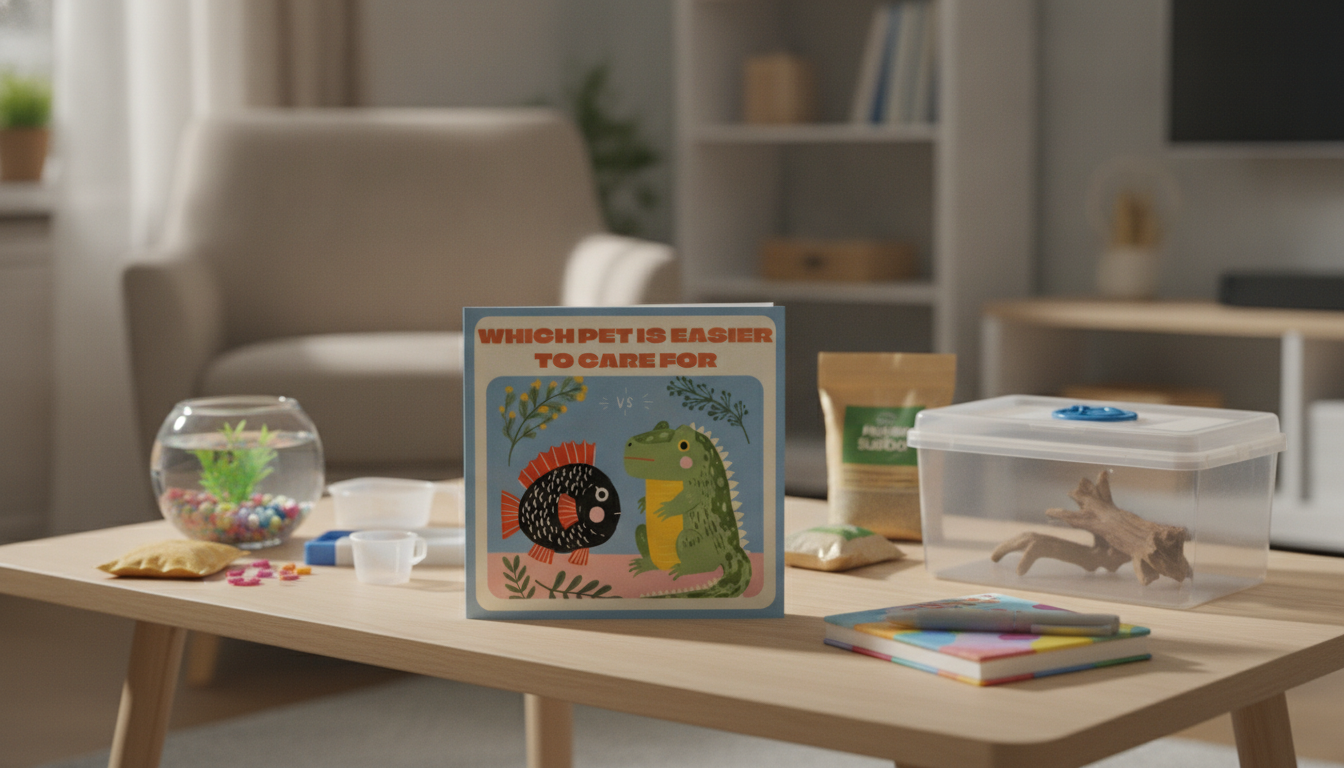
Fish and reptiles can both be rewarding first pets, but “easy” depends on the kind of daily routine desired, the tolerance for equipment upkeep, and comfort with live feeding or insects. This guide compares common beginner setups, ongoing tasks, typical costs, and frequent mistakes so a first-time pet parent can pick the option that fits their schedule and home. For more guidance, see APPA 2025 Fish & Reptile Report: Ownership Trends & Insights.
Before comparing species, it helps to define what “easy” looks like in real life. Most beginner struggles aren’t about the animal’s personality—they’re about how consistently the environment can be kept stable. For further reading, see How To Take Care of Fish: Beginner Guide – PetMD.
Fish care succeeds when the tank is appropriately sized, fully cycled, and consistently maintained. Reptile care succeeds when the enclosure is set up to match the animal’s natural needs—especially temperature gradients, humidity, and (for many species) UVB lighting.
| Category | Fish (community freshwater tank) | Reptile (beginner species enclosure) |
|---|---|---|
| Daily tasks | Feed (often 1–2x/day), observe behavior, remove uneaten food | Feed (varies by species), check temps/humidity, spot-clean |
| Weekly tasks | Test water, partial water change, glass/algae wipe | Deep-clean as needed, replace soiled substrate, sanitize items (species-safe) |
| Equipment focus | Filter, heater (many setups), light, test kit | Thermostat, heat source, UVB (often), hygrometer, hides |
| Stability challenges | Ammonia/nitrite spikes, overstocking, missed water changes | Incorrect temps/UVB, dehydration, stuck shed (some species) |
| Handling | Limited (netting stresses fish) | Possible, but must be gentle and species-appropriate |
| Common beginner pitfall | Tank not cycled before adding fish | No thermostat/incorrect UVB placement or bulb schedule |
Most “easy pet” stories leave out the initial setup learning curve. For fish, the biggest hurdle is the nitrogen cycle—adding fish before beneficial bacteria establish can lead to toxic ammonia and nitrite. For reptiles, the most common early mistake is uncontrolled heating (no thermostat) or incomplete lighting (missing or incorrect UVB for the species).
Size matters for both. Small tanks and small enclosures swing faster: water chemistry changes more quickly in a tiny aquarium, and temperatures/humidity fluctuate faster in a cramped habitat. Beginners often find that choosing a setup slightly larger than the minimum makes routine care more forgiving.
Fish health problems commonly trace back to stress and water quality. Good prevention includes stable parameters, not overfeeding, not overstocking, and quarantining new arrivals when possible. For general fish care guidance, the ASPCA’s fish care resources are a helpful baseline.
Reptiles are highly dependent on correct husbandry. Inadequate UVB or calcium support can contribute to metabolic bone disease, and incorrect temperature/humidity can lead to respiratory illness, dehydration, and shedding issues. Before choosing a reptile, confirm access to an exotics veterinarian; the AVMA’s guidance on choosing a pet is a useful starting point for planning long-term care and costs.
They can feel low-maintenance day-to-day once a tank is mature and stable, but they’re maintenance-heavy upfront because cycling, equipment setup, and water testing matter. Consistent weekly water changes are still required, and tiny tanks are usually harder to keep stable than larger ones.
“Easiest” depends on comfort with insects or frozen/thawed prey, available space, and whether the species needs UVB and tighter humidity control. Commonly recommended beginner options include leopard geckos, crested geckos, and corn snakes, but it’s important to verify adult size, lifespan, and local exotics vet access before choosing.
Fish costs are often steadier (food, conditioner, test supplies), while reptiles can cost more in electricity and recurring UVB bulb replacements, with diet making the biggest difference. A well-planned setup for either can avoid expensive fixes later.





Leave a comment