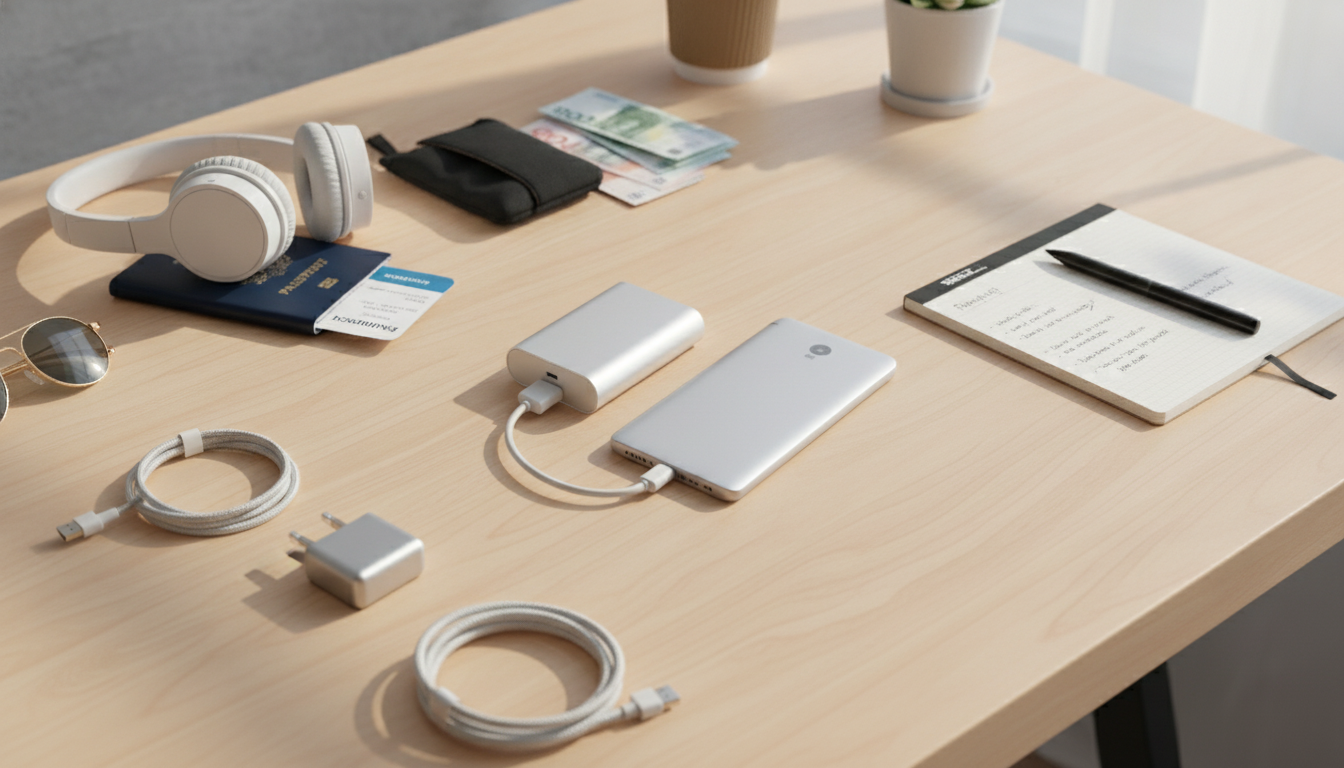
Power banks are one of the most common items flagged at airport security because they contain lithium batteries. The good news: most are allowed on flights when packed correctly and kept within airline limits. The details that trip people up are usually practical ones—carry-on vs. checked baggage, watt-hour limits, quantity caps, labeling expectations, and what happens when an airline’s policy is stricter than the general standard. Use the guidance below to reduce the chance of extra screening, delays at the gate, or a last-minute confiscation.
Power banks may look harmless, but their lithium-ion or lithium-polymer cells can present a fire risk if they’re damaged, short-circuited, or overheated. That’s why airlines and regulators focus less on the gadget itself and more on the battery inside it.
A key concept is cabin access. If something starts to overheat in the cabin, the crew can intervene quickly. If it happens in checked baggage, it can go unnoticed longer. As a result, most restrictions focus on (1) where the power bank is packed, (2) the battery’s size in watt-hours (Wh), and (3) how many you carry.
For most airlines and under many national regulations, power banks should be packed in carry-on baggage—not checked luggage. Even when certain installed lithium batteries are allowed in checked bags under specific conditions, power banks are commonly treated as “spare” lithium batteries, which are handled more strictly.
Practical tip: keep your power bank easy to access. Some airlines may request that lithium battery devices remain with the passenger (or at least not buried in an overhead bin) during particular situations, such as when they’re concerned about overheating or during certain phases of flight.
Airlines and regulators typically categorize lithium batteries by watt-hours (Wh), not just mAh. mAh is still useful, but it doesn’t tell the whole story unless you include the battery voltage.
To calculate Wh, use: Wh = (mAh ÷ 1000) × Voltage (V). Many power banks use a nominal 3.7V cell rating. Examples using 3.7V:
If Wh is printed on the power bank, use that number. If it isn’t printed, be aware that some airlines and security checkpoints may deny the item if capacity can’t be verified quickly.
| Battery size category | What it usually means for power banks | Typical allowance (may vary by airline) |
|---|---|---|
| Up to 100 Wh | Most common consumer power banks (roughly up to ~27,000 mAh at 3.7V) | Allowed in carry-on; quantity limits vary |
| 101–160 Wh | Larger packs (often high-end travel or camera/production packs) | Often allowed with airline approval; limited quantity |
| Over 160 Wh | Very large battery packs | Commonly prohibited for passengers |
Even when each power bank is under 100 Wh, many airlines limit the number of spare lithium batteries per passenger. There isn’t one universal “right” number across all carriers, so it’s smart to check the operating airline for each flight segment.
For larger power banks (commonly 101–160 Wh), pre-approval is often required, and quantities are usually limited to a small number. Approval can mean contacting the airline in advance, noting it in your reservation, or declaring it at check-in—procedures vary.
If you’re on a codeshare or partner itinerary, the operating carrier’s policy typically controls what you can bring onboard, even if your ticket was purchased through a different airline brand.
Most “power bank problems” at the airport are simple preventable issues: loose terminals, questionable condition, or suspicious packing. A few minutes of prep helps:
Generally no—power banks are typically treated as spare lithium batteries and are expected to be in carry-on. Airline and country rules can be stricter, so confirm the operating carrier’s policy for your specific itinerary.
Most travelers have the easiest time with power banks up to 100 Wh. Larger power banks (often 101–160 Wh) may require airline approval and can be limited in quantity; above 160 Wh is commonly not allowed.
Use Wh = (mAh ÷ 1000) × V. Many power banks use a nominal 3.7V rating, and if the Wh rating is printed on the unit, that printed value is the best number to use for airline checks.





Leave a comment