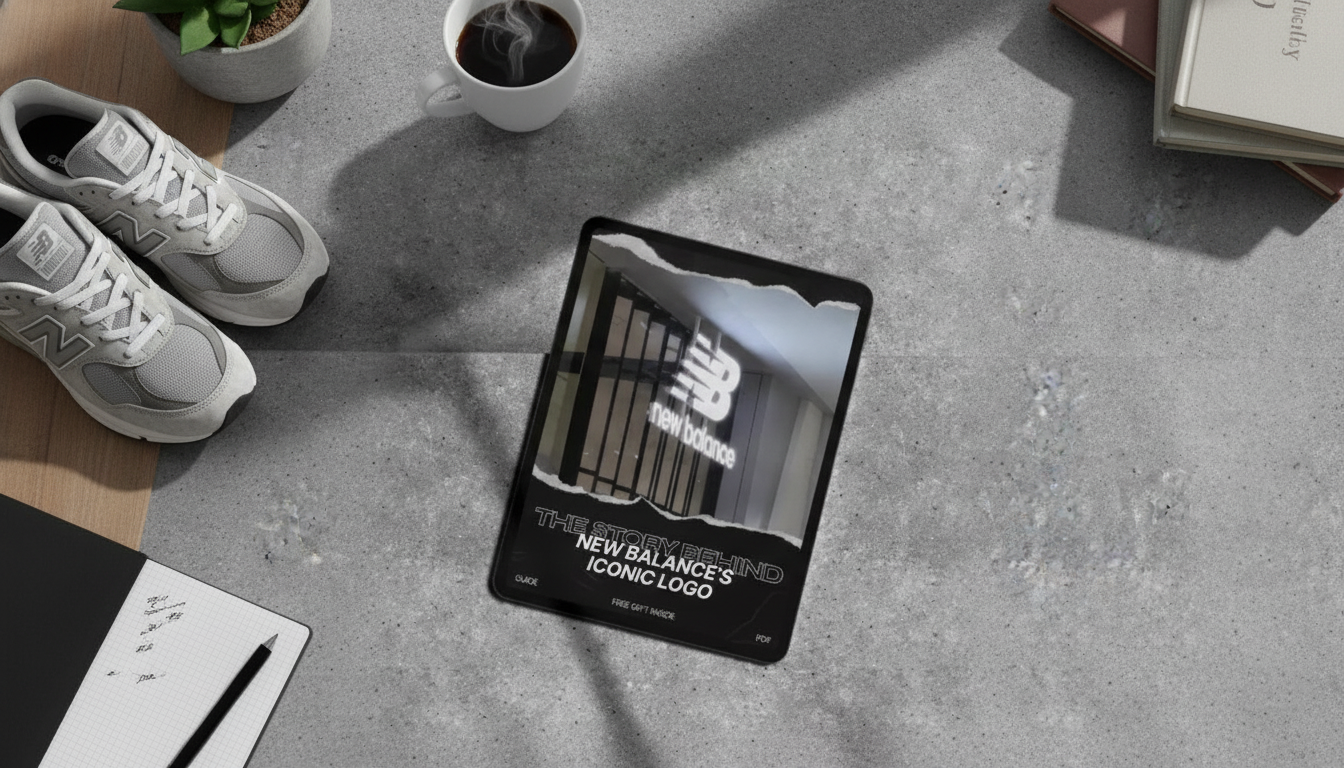
New Balance’s logo looks simple at a glance: a bold “N” built for speed and visibility. Its lasting impact comes from how the mark balances performance cues, legibility at distance, and consistent brand signals across decades of footwear and apparel. The result is a badge that works as design, identification, and (in some cases) a subtle nod to heritage—all while staying readable on a fast-moving product.
To understand why the “N” has endured, it helps to look at how it functions on real shoes: curved sidewalls, layered materials, reflective accents, and panels that flex with every stride. When a logo still reads clearly through all that motion and texture, it’s doing more than decorating—it’s doing a job.
A single-letter mark is one of the fastest visual identifiers in footwear. When shoes are in motion—feet mid-stride, runners passing, a quick glance in a crowded street—complex wordmarks can blur. A bold “N” is immediate.
New Balance also benefited from the logo’s natural “billboard” location: the lateral side panel. That area is visible from a distance, yet often narrow and interrupted by seams, overlays, and lace structures. The “N” solves the constraint by being blocky and high-contrast, with a silhouette that stays recognizable even when scaled up or down.
Over time, repetition did the rest. Once consumers learn that the “N” equals New Balance, the letter can stand alone—no extra wording required. That consistency becomes its own kind of meaning: reliability, familiarity, and an easy-to-spot signal across many models.
Early branding leaned more heavily on wordmarks and product labeling. As athletic footwear culture grew and side-panel logos became a category norm, New Balance’s “N” expanded into a stronger, more central role.
As silhouettes adopted chunkier panels and layered builds—mesh bases, suede overlays, synthetic reinforcements—the logo adapted. Sometimes it appeared as a stitched-on appliqué; other times as a printed graphic, reflective insert, or layered overlay integrated into the panel structure.
Most changes weren’t dramatic rebrands. They tended to be refinements focused on clarity, reproducibility, and contrast across mixed materials—practical upgrades that kept the letter readable and manufacturable. For brand context and corporate history, New Balance’s official background is outlined on New Balance — Our Story, while a high-level company overview is available at Wikipedia’s New Balance entry.
| Era (high-level) | Visual cues | Practical reason | Where it shows up most |
|---|---|---|---|
| Early-to-mid adoption of the “N” | Bold letterform, strong outline presence | Instant side-panel recognition | Running and lifestyle silhouettes |
| Performance-focused refinements | More emphasis on speed lines/striping, stronger contrast | Legibility at distance and in motion | Training and technical models |
| Modern consistency across product families | Cleaner geometry, adaptable finishes (stitched, printed, reflective) | Scales across materials and manufacturing methods | Footwear, apparel, collaborations |
The “N” doesn’t rely on a mascot or illustration to communicate energy. Instead, it borrows cues from industrial design and performance graphics—built around weight, angle, and negative space.
Because the “N” is minimal, most of its symbolism comes from how it’s used—not from a character or story printed into the graphic itself.
For readers curious about trademark usage and how brands protect visual identifiers, the USPTO trademark search (TESS) is a useful starting point for understanding how marks are cataloged and referenced.
It primarily communicates motion and performance through bold weight, directional slants, and occasional striping that reads like speed lines. Just as important, its long-term consistency makes it a shorthand for reliability and familiar brand identity.
Yes, but mostly through incremental refinements aimed at clarity, contrast, and manufacturability across different materials and construction methods. Many variations are tied to model categories and production techniques rather than a total redesign.
The lateral side panel is the most visible surface when a person is walking or running, so it functions like a natural billboard in motion. That placement also works well with overlays and stitching, helping the logo stay durable and readable on a curved, high-wear area.





Leave a comment