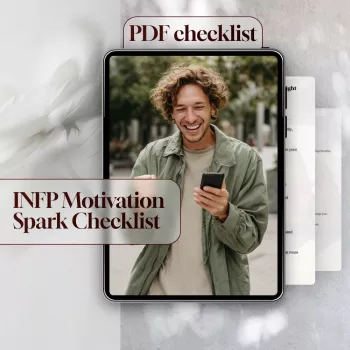
Motivation for many INFPs isn’t about pushing harder—it’s about reconnecting to meaning, values, and a sense of gentle momentum. When the day feels foggy, the problem often isn’t laziness; it’s misalignment: the task doesn’t feel connected to what matters, the expectations feel too big, or the environment quietly drains your energy. A simple, values-led checklist can turn “I should” into “this matters,” without forcing you into a rigid productivity persona.
If you want a low-pressure way to start (and restart) your day, The INFP Motivation Spark Checklist: Light Your Inner Fire Every Day! (Digital Download) is built for reflective, creative minds that do best with gentle structure and clear next steps.
INFP motivation often runs on meaning more than momentum. That’s not a flaw—it’s a design feature. When the “why” is alive, energy shows up. When it’s missing, even simple tasks can feel strangely heavy.
This approach aligns with research that highlights autonomy, competence, and relatedness as core psychological needs that support motivation (see Deci & Ryan’s work on Self-Determination Theory). It also helps to remember that “motivation” isn’t a personality trait; it’s a state influenced by context and meaning (APA definition: motivation).
Instead of trying to “fix” your personality, the checklist focuses on creating conditions where your natural motivation can return. It’s less about grinding and more about guiding yourself back to clarity.
For INFPs, consistency usually grows from kindness plus clarity: a small plan you can actually keep. That’s the point—something you’ll return to even when you’re not “in the mood.”
The fastest way to get unstuck is often to stop arguing with your current state and work with it. This five-step flow keeps the tone supportive while still moving you forward.
That last step matters: many INFPs burn out by using only pressure as fuel. A small reward teaches your nervous system that effort is safe—and repeatable.
On days when you don’t want to think about the process, use a simple matching system: pick the row that fits your energy, follow it exactly, and stop negotiating with yourself. The goal is to rebuild trust: “When I feel like this, I know what to do next.”
| Today feels like… | Best first step (5–10 min) | Next step (10–20 min) | Protect the spark |
|---|---|---|---|
| Foggy / unmotivated | Write 3 words: what matters today | Do one tiny task that supports that value | Remove one distraction (phone tab, clutter, noise) |
| Anxious / overwhelmed | List 2 worries, then circle what’s controllable | Do the smallest controllable action | Set a gentle timer + stop when it ends |
| Inspired but scattered | Choose one theme for the day | Make a short “done list” goal (1–3 items) | Park new ideas in a note to prevent spiraling |
| Steady / focused | Clarify the next milestone in one sentence | Work in a single focused sprint | End with a short reflection: what worked today? |
To keep the routine supportive (not isolating), consider pairing your motivation practice with a confidence/connection skill set that helps you ask for clarity, set boundaries, or communicate needs. Speak Easy: How to Talk to Anyone with Confidence and Authentic Charm can complement the checklist when your motivation dips due to social stress, unclear expectations, or difficulty speaking up.
If you’re curious about personality type basics, the Myers & Briggs Foundation MBTI overview is a helpful starting point for understanding common preferences (while remembering that everyone is more nuanced than a label).
It’s designed around common INFP motivation patterns—values, meaning, overwhelm, and the need for autonomy—but any reflective, creativity-driven person can adapt it and benefit from the prompts.
The check-in typically takes about 3–10 minutes, and you can add an optional 10–20 minute action sprint. On low-energy days, the smallest version is still effective.
Return to the minimum routine (one feeling + one “why” sentence + one tiny task) and look for friction points during a weekly review. Consistency beats intensity, especially for meaning-driven motivation.






Leave a comment