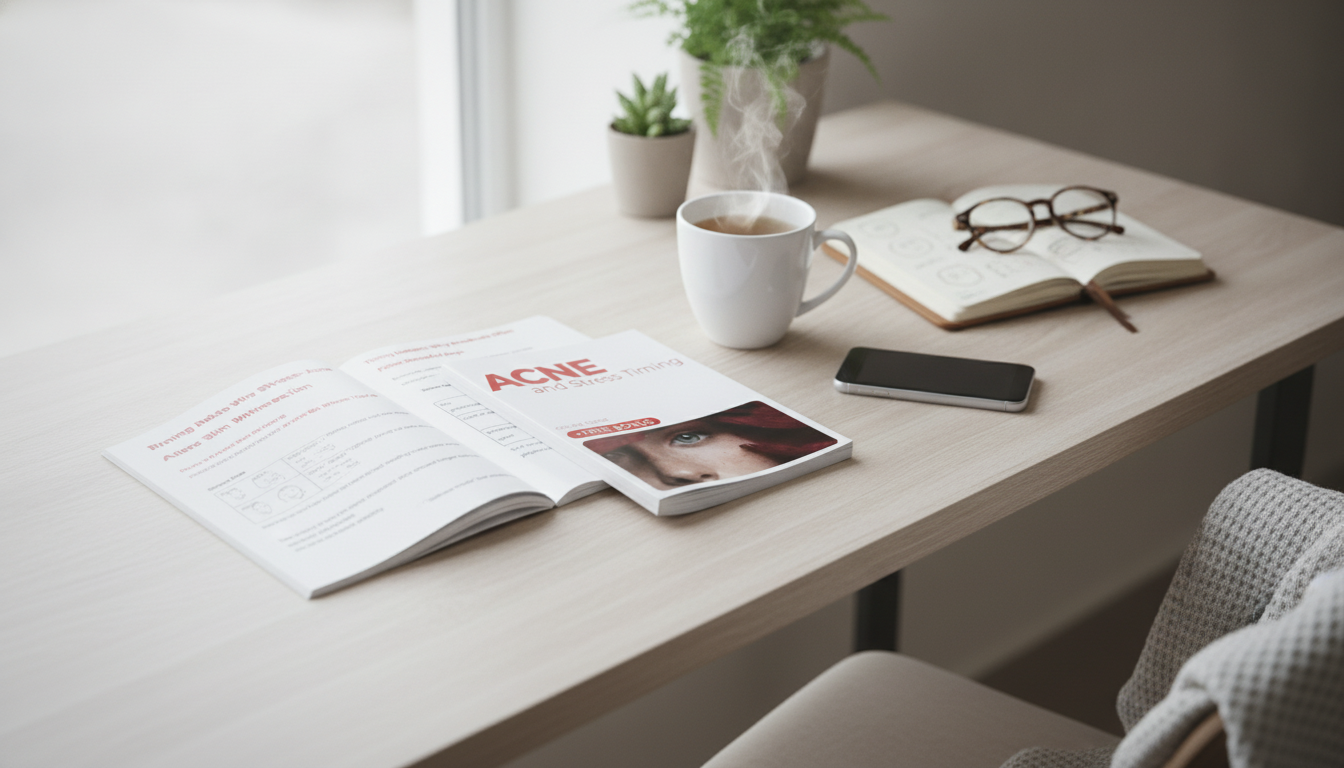
Stress-related breakouts can feel random—until you start noticing a repeatable delay. A stressful trigger happens, stress hormones and inflammatory signals rise, routines slip, and your skin reacts days later. Understanding that lag helps you tell the difference between coincidence and pattern, respond in the right “window,” and avoid changing your skincare so often that you can’t tell what’s actually helping.
Stress doesn’t usually create acne out of nowhere. More often, it turns up the volume on pathways that were already active: oil production, inflammation, slower healing, and a higher chance that tiny clogs become angry, visible pimples.
When you experience stress, your body activates the HPA axis (brain-to-adrenal signaling). That cascade can increase cortisol and related mediators that influence sebum, inflammation, and the skin’s ability to recover. If you’re already prone to clogged pores, that shift can be enough to push borderline microclogs into a noticeable breakout—especially when stress also changes sleep, diet, and how often you touch your face.
Common delayed effects include shinier skin, more redness, slower fading of old spots, and a greater likelihood that existing clogged pores become tender or inflamed.
Acne lesions don’t form instantly. Even when stress is the spark, there’s usually a ramp-up period before you see a new cluster. This is a practical timing guide—not a strict rulebook—because everyone’s skin, baseline routine, and hormone patterns differ.
You might notice flushing, increased oiliness, or that existing inflamed pimples look more irritated. This window is also when stress habits (touching, picking, skipping cleansing, friction from masks/helmets) can do immediate damage.
Inflammation often ramps up. Small clogged pores can become sore bumps, particularly on the cheeks and jawline. Poor sleep and dehydration tend to show up here.
This is when many stress-linked breakouts become clearly visible. It’s also when cumulative stress behaviors—late nights, irregular meals, more sugar/alcohol, inconsistent skincare—start to matter.
With chronic stress, the “timing” can feel like nonstop acne: slower healing, more frequent new lesions, and lingering redness. The trigger is less one event and more an ongoing load.
| Timing after stressor | What you might notice | Likely contributors | Helpful next step |
|---|---|---|---|
| 0–24 hours | Redness, shinier skin, existing spots more irritated | Cortisol surge, increased touching, friction (mask/helmet), missed cleansing | Keep routine simple; avoid picking; reduce friction; calm inflammation |
| 1–3 days | Tender bumps, more clogged pores becoming noticeable | Inflammation + oil changes; disrupted sleep; skipped workouts or hydration | Prioritize sleep and gentle actives; avoid harsh scrubs; spot-treat inflamed lesions |
| 3–7 days | Clear breakout cluster, often in familiar zones | Cumulative stress behaviors (diet changes, late nights), ongoing inflammation | Review trigger log; adjust routine consistency; consider benzoyl peroxide/adapalene if tolerated |
| 1–3 weeks | Slow healing, frequent new lesions | Chronic stress, elevated inflammation, routine inconsistency | Build a sustainable plan; consider professional guidance if persistent |
Not all stress looks the same on skin. Some triggers are sharp and short; others quietly accumulate until your skin starts acting “off.”
For foundational acne guidance and treatment options, the American Academy of Dermatology is a helpful starting point. For understanding the body’s stress response, see Harvard Health Publishing, and for coping strategies, the National Institute of Mental Health offers practical resources.
A little structure goes a long way. A 30-day log is usually enough to spot whether you have a consistent lag window.
Many people notice changes within 1–3 days, with a more obvious breakout commonly showing up around 3–7 days after a stressor. Same-day effects are often redness or irritation of existing spots, while chronic stress can worsen acne over 1–3 weeks.
It can make existing pimples look angrier or more swollen overnight, and stress behaviors (touching, friction, skipped cleansing) can irritate skin quickly. Truly new inflamed lesions often take longer than one night to develop.
Stress acne often follows an event-linked lag (for example, a few days after deadlines), while hormonal acne tends to follow a cycle-linked pattern month to month. Tracking timing plus location and lesion type can clarify the pattern, and persistent or scarring acne is worth discussing with a clinician.






Leave a comment