Landing a first freelance client is rarely about luck; it’s about choosing a clear service, targeting the right people, and repeating a simple outreach routine until someone says yes. The fastest path is to stop “getting ready” and start running a lightweight system: one offer, one audience, a small proof stack, and consistent outreach with follow-ups.
Early on, the goal isn’t to showcase every talent—it’s to make it easy for someone to buy one specific outcome. Pick one service to lead with for the first client, such as landing page copy, a logo refresh, bookkeeping cleanup, or short-form video edits.
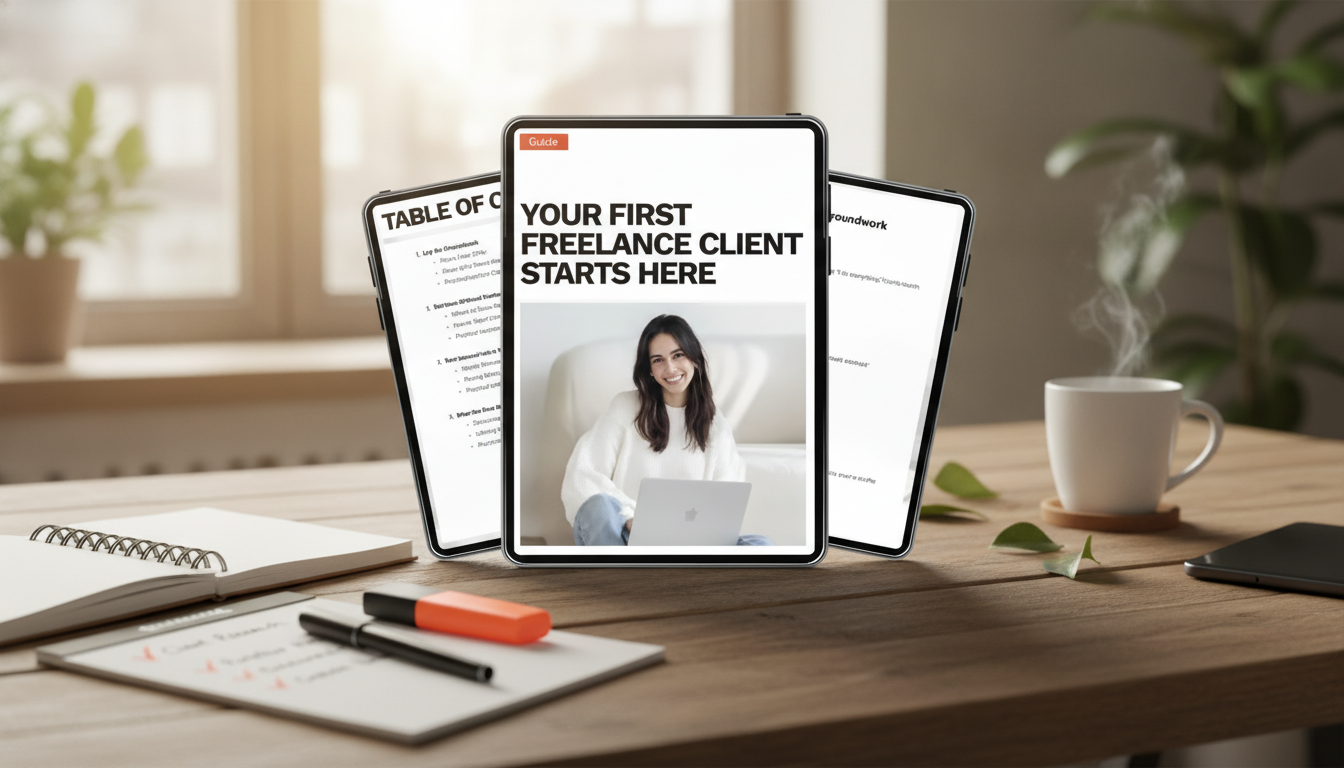
If you want a ready-to-use workflow (offer templates, weekly targets, and a fill-in checklist), keep Your First Freelance Client Starts Here – Step-by-Step Guide on How to Get Your First Freelance Client, eBook, Checklist for Beginners nearby while you set up your first week.
Proof doesn’t need to be fancy—it needs to be relevant. A clean, niche-matched presentation beats an elaborate portfolio filled with unrelated work.
For service positioning, a LinkedIn Service Page can help prospects instantly understand what you do (and it’s quick to set up). See LinkedIn’s help resource here: LinkedIn — Service Pages (help resource).
Your first client is often closer than expected. Start where trust already exists, then expand to targeted cold outreach.
| Use case | Message skeleton | Best next step |
|---|---|---|
| Cold outreach (email/DM) | Hi {Name}—loved {specific detail}. Noticed {specific opportunity}. If helpful, can {simple deliverable} to help you {result}. Want me to send a quick Loom? | Send Loom or 2–3 bullet suggestions |
| Warm referral ask | Hey {Name}—quick ask: do you know any {niche} who need help with {service}? I’m taking 1 new project and can deliver {deliverable} in {timeframe}. Happy to share samples. | Ask for an intro or permission to name-drop |
| Follow-up #1 | Circling back—one more thing I noticed: {insight}. If you want, I can share {mini plan} and you can decide if it’s worth doing now. | Offer a 10-minute call or Loom |
| Follow-up #2 | Last note from me—if {goal} is a priority this month, I can help with {deliverable}. Either way, here’s a quick idea: {tip}. | Close the loop; invite future contact |
As you earn income, it’s worth getting familiar with basic self-employment basics like recordkeeping and tax responsibilities. The IRS hub is a good starting point: IRS — Self-Employed Individuals Tax Center.
If confidence during outreach is the main blocker, Speak Easy: How to Talk to Anyone with Confidence and Authentic Charm can help you keep messages natural, calm, and direct—especially for follow-ups and discovery calls.
When you’re ready to formalize your plan a bit more, the SBA’s guidance can help you outline services, pricing, and positioning without turning it into a huge project: U.S. Small Business Administration (SBA) — Write your business plan.
With consistent outreach and follow-ups, many beginners land their first client in a few days to a few weeks. The timeline depends on how many targeted messages you send, how clear your offer is, and whether your proof stack matches the niche.
Working free can be strategic only if it’s limited, tied to a specific deliverable, and exchanged for a testimonial or case study. In most cases, a small paid starter package sets healthier expectations and attracts more serious buyers.
Start with warm contacts and local businesses because trust is already partially built, then expand to targeted outreach on LinkedIn or niche communities. Marketplaces can work too, but avoid spray-and-pray applications and focus on a tight niche plus a strong first message.





Leave a comment